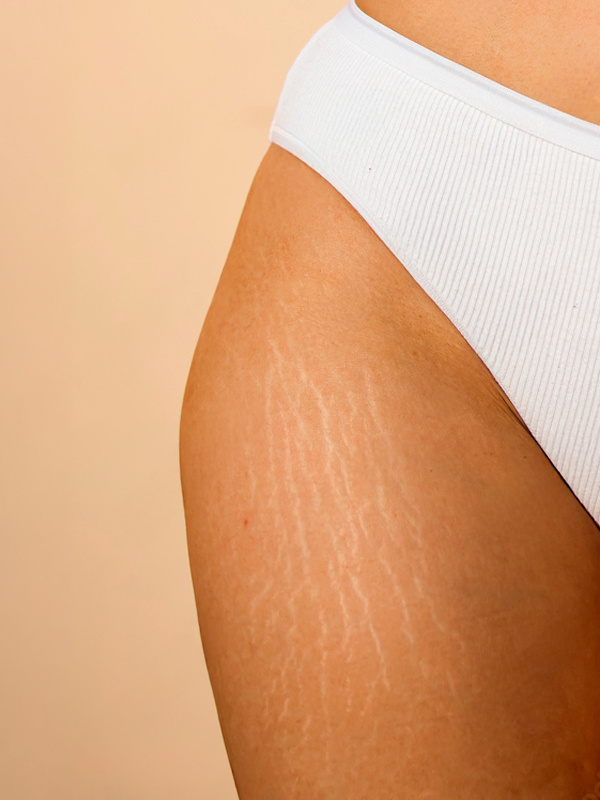
Stretch marks
Understanding Stretch Marks and Treating Them Effectively
Stretch marks are a very common skin imperfection that can affect both men and women of all ages, caused by the rupture of collagen and elastin fibers within the dermis. They appear as linear streaks on the skin, initially red or purplish in color, which tend to become white over time.
This skin condition is particularly common after significant weight changes or during pregnancy. Although it does not represent a health problem, it may cause aesthetic discomfort and affect self-esteem. Fortunately, there are effective and targeted treatments available to improve the appearance of stretch marks and reduce their visibility.
Stretch marks are skin lesions similar to scars, caused by a loss of elasticity in the elastic fibers of the dermis, the middle layer of the skin. They result from atrophic changes in the skin in areas more prone to fat accumulation, such as the inner thighs, hips, buttocks, breasts, and abdomen.
Stretch marks appear on the skin in different stages and with different characteristics. During the first phase, the inflammatory stage, itching may occur and this is the moment when the cells responsible for collagen production, subjected to excessive stress, begin to alter their activity.
In the second phase, known as the regeneration stage, fibroblasts continue their activity but the fibers still break, leading to the formation of reddish streaks (red stretch marks). Treating stretch marks at this stage offers a greater chance of success.
In the third stage, stretch marks take on the typical grayish-white color (white stretch marks): over time, the rupture of the fibers becomes scarred, blood vessels constrict, and treatment becomes more difficult.
The causes of stretch marks are numerous and may vary from person to person. Among the most common are:
- Weight changes: sudden weight fluctuations are one of the most frequent causes of stretch marks, as the skin does not have enough time to adapt to these changes.
- Pregnancy: during pregnancy, especially in the last trimester, the abdominal skin stretches considerably, often causing stretch marks on the stomach and breasts.
- Adolescent development: puberty is a phase characterized by rapid body changes, such as increased muscle mass in boys or breast development in girls, which may lead to stretch marks.
- Genetic factors: genetic predisposition can influence the development of stretch marks. Some individuals are more prone to loss of skin elasticity and the appearance of stretch marks.
- Hormonal imbalances: hormones can have a significant impact on skin elasticity. High cortisol levels, for example, may reduce collagen production, making the skin more susceptible to stretch marks.
- Prolonged use of corticosteroids: long-term use of corticosteroid-based medications can weaken the skin’s elastic fibers and promote the appearance of stretch marks.
The Dermacademy Institute offers a range of advanced aesthetic treatments to improve the appearance of stretch marks and reduce their visibility, restoring a smoother, firmer, and more even-looking skin. Thanks to the expertise of our specialists, every treatment plan is carefully designed and personalized to meet the specific needs of each patient.
After an accurate evaluation of the type of stretch marks, the skin phototype, and the overall condition of the skin, our experts will define a tailored protocol that combines the most advanced technologies to stimulate tissue regeneration and promote the progressive reduction of the streaks.
Through a combination of modern, safe, and non-invasive techniques, it is possible to achieve visible and long-lasting results, improving the skin’s appearance and restoring confidence in one’s image.
Treatments for Stretch marks
How it works
Carboxytherapy consists of the injection of carbon dioxide (CO₂) into the subcutaneous tissue with the aim of improving microcirculation, reducing cellulite, and diminishing the appearance of dark circles.
Goals
This treatment stimulates lipolysis (the breakdown of fats) and increases tissue oxygenation. It is indicated for improving skin firmness and reducing aesthetic imperfections.
How it works
Mesotherapy (or intradermotherapy) is a medical-aesthetic treatment that involves the injection of targeted active substances directly into the dermis or subcutaneous tissue. Thanks to localized microinjections, it is possible to address specific skin imperfections such as cellulite, fluid retention, and localized fat deposits, promoting a visible improvement in skin quality.
Goals
The treatment aims to improve imperfections related to cellulite and fluid retention by promoting a lipolytic and firming action. Through personalized protocols, mesotherapy makes it possible to reshape the treated areas, improve tissue tone, and address stretch marks or skin laxity.
How it works
Microneedling uses microneedles to create microchannels in the epidermis, stimulating the skin’s natural regenerative process. This mechanism activates the production of collagen and elastin, improving skin texture and reducing imperfections such as scars and wrinkles.
Goals
The main goal of microneedling is to promote cellular renewal and encourage smoother, firmer, and more even skin. Thanks to its ability to stimulate the skin’s natural repair processes, it is an effective solution for scars, acne marks, and other skin irregularities.
How it works
Biodermogenesi uses a vacuum massage system combined with electrical stimulation that reactivates microcirculation and promotes tissue oxygenation. This process stimulates cellular regeneration, improving the appearance of the skin and repairing its visible imperfections.
Goals
The main goal is to reduce the visibility of stretch marks and scars, restore firmness and compactness to the skin in order to counteract the signs of aging, and improve skin elasticity. The result is a harmonious and natural-looking effect that is long-lasting over time.
How it works
Prime X combines ultrasound and radiofrequency to achieve visible results in different areas of the body. The programmed pulse ultrasound emits shock waves that selectively act on fat cells. The radiofrequency, supported by a handpiece with a rotating massage system, generates heat deep within the tissues.
Goals
The main effect of the Prime X treatment is the reduction of localized fat and the reshaping of body contours. Those affected by cellulite will notice a reduction in its appearance and an improvement in skin texture, together with firmer tissues, for a more toned and defined body.
Book a specialist consultation
The health and peace of mind of our patients are always our priority. We have developed a method that guarantees a personalized treatment journey through a process that begins with listening.
Book a specialist consultation at the Dermacademy Institute.


