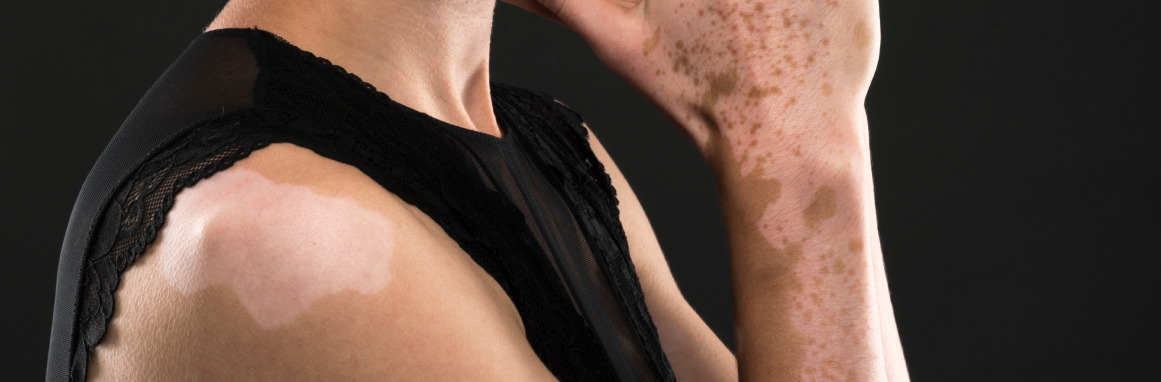

Tattoos and Vitiligo: Let’s Clarify the Facts
Our patients affected by vitiligo often ask us whether they can safely get tattoos without risking the appearance of a new vitiligo patch in the tattooed area.
The answer is: it depends.
Tattooing itself (when performed with proper technique and high-quality pigments) does not cause vitiligo, which might suggest that patients can safely get new tattoos without concern.
However, vitiligo, like other skin conditions such as atopic dermatitis and psoriasis, is associated with a phenomenon called reactive cutaneous isomorphism, also known as the Koebner phenomenon (named after the physician who first identified it, albeit in a rather unusual way).
This phenomenon is characterized by the appearance of lesions of the disease in areas affected by trauma during periods of disease worsening. In vitiligo, this means that cuts, burns, tattoos, and other forms of skin trauma may lead to the formation of a vitiligo patch corresponding to the exact shape and location of the trauma itself.
How can the risk of developing a vitiligo patch within a tattoo be reduced? It is not possible to completely eliminate the risk; however, it is quite uncommon for such a patch to develop if the tattoo is performed during a phase in which vitiligo is improving. On the other hand, it is much more likely to occur if the tattoo is done during a stable phase or during disease progression.
For this reason, we strongly recommend consulting your trusted dermatologist to determine whether it is the right time to get a tattoo.
But what should be done if a patch does appear?
Vitiligo patches triggered by the Koebner phenomenon can undergo repigmentation, just like other vitiligo lesions. In many cases, they may even repigment more easily, provided that appropriate and effective vitiligo treatment is followed.


