
Melanoma and Prevention: The Importance of Mole Mapping
May is the Melanoma Prevention Month, and for this reason the Dermacademy Institute in Pisa would like to once again emphasize the life-saving importance of regular mole checks.
Melanoma is a malignant skin tumor caused by the degeneration of melanocytes, the cells responsible for melanin production. Melanoma may develop from an existing mole, but more often appears as an independent lesion. Undergoing regular screening allows the observation of possible changes or evolution of moles over time.
To prevent melanoma, a simple yet accurate examination such as mole mapping is sufficient, and it should ideally be performed at least once a year. Thanks to this type of monitoring, it is possible to identify, diagnose, and treat a wide range of dermatological conditions early.
Mole Mapping: A Minimally Invasive Examination That Can Save Lives
Mole mapping is a non-invasive examination that allows the monitoring and evaluation of all pigmented skin lesions. The purpose of the investigation is to identify any atypical lesions, monitor the evolution of moles over time, and detect the possible presence of skin cancer. Mole mapping represents the most important diagnostic examination for the early detection of skin tumors and for maximizing the chances of successful treatment.
This type of examination should be performed at least once a year starting from adolescence, and is particularly recommended for individuals with fair skin phototypes, those who have undergone tanning lamp sessions, those who have experienced more than 7 sunburns in a single year, patients with a family history of melanoma, and those who have previously had melanoma.
The Dermacademy Institute Method for Mole Mapping
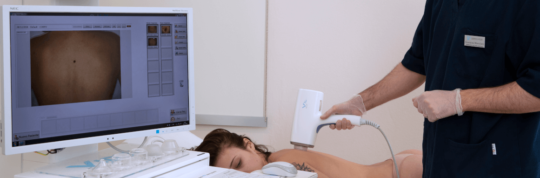
Mole mapping is performed using advanced devices capable of analyzing the internal structure of lesions and allowing the specialist to archive dermoscopic images over time, making it possible to identify any signs of alteration during follow-up visits. For mole mapping, the specialists at the Dermacademy Institute use two of the world’s leading systems for computerized digital dermoscopy (Fotofinder, Vidix).
The purpose of this instrumental investigation is to create a sort of map describing the shape, location, size, and color of the patient’s moles. The first screening will later serve as a comparison tool for evaluating existing moles and identifying the appearance of new ones. At the Dermacademy Institute, analysis results are stored using advanced encryption methods for more than 10 years (or for as long as the patient wishes), allowing specialists to clarify any doubts regarding the actual growth of a mole even after many years.
Self-Examination: A First Step in Identifying Suspicious Moles
Alongside an accurate dermatological examination, it is essential to perform a self-assessment of your moles at least once a year, even using photographs, in order to identify suspicious lesions early.
In this process, it is useful to follow the well-known ABCDE rule, an observation method based on five criteria used to distinguish normal moles from suspicious ones.
Let’s look at them:
- Asymmetry: one half of the mole may not match the other. The more asymmetrical the mole is, the more suspicious it should be considered.
- Borders: particular attention should be paid to lesions with irregular or poorly defined borders.
- Color: if the color is not uniform and shows different shades ranging from brown to black, or from red to blue and white, the mole may be suspicious.
- Diameter: it should be remembered that melanomas usually have a diameter greater than 6 mm; however, they may also be smaller at the time of diagnosis.
- Evolution: if part of the mole or the surrounding skin appears to evolve or change, it should raise concern.
The first thing to do if one of these characteristics emerges during self-examination is to schedule a dermatological check-up as soon as possible in order to obtain a reliable diagnosis.
The specialized staff of the Dermacademy Institute in Pisa will provide you with all their expertise and professionalism.


